Odoo Alternatives (2026): 12 Compared, With Prices
Twelve Odoo alternatives sorted by what you run in Odoo, with US prices checked on October 15, 2026, and what Odoo's new Light User rule changes.
By Opusite Team · Updated

The right Odoo alternative depends on which part of Odoo you actually use. For another open-source ERP, ERPNext is the closest match: the software is free, and Frappe hosts it from $5 a month for a site, not per user. For a cloud suite that sells many apps under one subscription and hosts them for you, Zoho One is $37 per employee a month billed yearly and Bitrix24 is $49 a month for up to 5 users. For a larger vendor's ERP, Microsoft Dynamics 365 Business Central is $80 a user a month paid yearly. For comparison, Odoo Standard is $24.90 a user a month billed yearly for the first 12 months, then $31.10.
This guide compares twelve alternatives, grouped by the job Odoo does for you, with every price read from the vendor's own US page on October 15, 2026. It also covers what Odoo changed in late September: a Light User licence at $8.90 a month, and a new rule that counts employee records with no login as users.
We make Opusite, one of the twelve. It costs more per seat than anything else here and it is not an ERP, so when we get to it we say exactly who it is for and who should skip it. The sources for every price are listed at the end.
The short answer
- You run stock, manufacturing or online sales in Odoo and want to stay open source: ERPNext or Dolibarr.
- You want one cloud subscription for many apps, without hosting anything yourself: Zoho One or Bitrix24.
- You want a big-name ERP and a partner to set it up: Business Central, SAP Business One or Acumatica.
- Odoo is mainly your inventory and order system: Cin7.
- You only use Odoo's CRM: HubSpot or Pipedrive.
- You only use Odoo's Project app: OpenProject.
- You are a service business of 5 to 20 people that uses Odoo for CRM, projects, help desk and chat, and you would rather not configure apps yourself: Opusite. It costs about six times Odoo Standard per seat in the first year, and it is set up with you.
Which Odoo app are you replacing?
Most people searching for an Odoo alternative are not leaving all of Odoo. They are leaving the part that hurts. Start from that part.
| If Odoo runs your... | Look at | Why |
|---|---|---|
| Whole business, and you want open source | ERPNext, Dolibarr | Both cover stock, projects and accounting, and both run on your own server or theirs |
| Inventory and orders | Cin7 | An inventory system first, with sales channels and warehouse plans |
| Manufacturing | ERPNext, Business Central Premium | Frappe lists manufacturing in ERPNext; Microsoft adds it in Premium |
| Accounting and finance | Business Central, SAP Business One, Acumatica | Bought and set up through partners, priced per user or per application |
| CRM only | HubSpot, Pipedrive | Self-serve CRMs with published per-seat prices |
| Project and Timesheets only | OpenProject | Open-source project management with a free Community edition |
| CRM, Project, Helpdesk and Discuss, for a service team | Opusite, Bitrix24, Zoho One | Customers, work and conversations in one product |
What changed at Odoo in September 2026
If you last read Odoo's pricing page in the summer, three things are different.
1. There is a Light User licence. Odoo's US pricing page now shows "Light User at US$ 8.90", a monthly price. A Light User can see their own time off, expenses, appraisals, attendances, referrals and planning, use Field Services and the Inventory Barcode Operator, and read Knowledge; as an employee they can get payslips, use the Point of Sale and use the Manufacturing shop floor. To get the licence, Odoo's page says to schedule a meeting with an Odoo advisor. The line is not on the copies of the page that the Internet Archive saved on August 11 and September 17, 2026; it is on the copy from September 25.
2. More people count as users. Until mid-September, Odoo's page described a paying user as "usually an employee who has access to the Odoo backend". Since the September 25 copy, it also counts "an employee (record in hr application) who has no linked user", and its Light User definition covers any active employee record in the HR app that is not linked to a user account. In plain terms: if you keep a record for every employee in Odoo's HR app, the people without a login are now on the bill, at the Light User rate. Customers and suppliers who only use the portal are still free.
3. A price rise was announced, without US figures. At Odoo Experience in Brussels, Odoo said it would make "a partial price increase of about 20%", its first in four years, according to The Brussels Times and Belga on September 24, 2026. The report says one app stays free and that the light-user category is available when a company has at least one full user. We found no Odoo page giving the new prices in dollars, so this guide uses only what Odoo's US page shows today: Standard and Custom were the same on October 15 as on August 11, and the Custom plan now lists "Odoo Studio / Agentic AI".
Check Odoo's page again before you sign anything. If a change lands after October 15, the numbers below will be out of date.
Why people look for Odoo alternatives
We read the pages Google showed for "odoo alternatives" and "odoo competitors" on October 15, 2026, the Reddit threads it showed beside them, and Odoo's own pricing, Success Pack and help pages. Six reasons come up.
1. The plan price is not the project price. Odoo's page lists what its plans do not include: implementation and expert services, hosting on Odoo.sh for custom development, in-app purchase credits (text messages, contact autocomplete, lead generation and AI scanning of bills and expenses) and maintenance of custom code. Setup is sold as Success Packs, from 4 hours for $580 to 200 hours for $25,000, with 15% off a new customer's first pack and travel billed on top. Odoo's own figure is the strongest argument for buying one: a "98% implementation success rate, vs 65% without success pack". For a six-person team, the 25-hour Basic pack ($3,600, or $3,060 for a first pack) costs more than a year of Standard licences ($1,792.80).
2. Customising moves you to the Custom plan. Odoo's FAQ says that if you install Studio or add companies to your database, "you will automatically switch to the Custom plan". Custom is $49 a user a month billed yearly in the first year and $61 after, against $24.90 and $31.10 for Standard: almost twice the price for everyone, not only the person who uses Studio. Connecting another system to Odoo's external API also needs Custom.
3. The first-year price ends. The Standard and Custom discounts are "valid for 12 months, for initial users ordered". People you add later, and everyone in year two, pay the regular price: $31.10 instead of $24.90 a user a month billed yearly, or $38.90 instead of $31.10 billed monthly.
4. More people count as users than you expect. Odoo's examples of paying users include an employee who only reports expenses or timesheets, and an outside accountant who works in your books. Add the new employee-record rule above, and a company with office staff in Odoo and field staff in the HR app pays for both.
5. Community is not the product on the pricing page. Odoo's free, self-hosted Community edition is not what its pricing page sells. Two competitors say what is missing from it, and both say so as rivals: OpenProject writes that custom fields and workflows in Odoo Project need extra apps such as Odoo Studio, "forcing an upgrade to a paid version", and Frappe, which calls its own opinion "entirely biased", marks the helpdesk and customisation as "Not available" in Community.
6. Upgrades and who holds the data. Odoo says upgrades are included in all its plans at no extra fee, and that on Odoo Online you can download a backup of your database at any time ("You own your data!"). OpenProject, again as a competitor, says that for self-hosted Odoo "no migration scripts are published" and that Odoo recommends handing your data over for an upgrade.
Prices, checked on October 15, 2026
Prices are in US dollars per month unless marked. For Odoo, Zoho One, Bitrix24, HubSpot and OpenProject, both the yearly-billing and the monthly-billing price are given.
| Tool and plan | Price on the vendor's US page | How it is charged | Free plan or trial |
|---|---|---|---|
| Odoo Standard | $24.90 billed yearly ($31.10 after 12 months); $31.10 billed monthly ($38.90 after) | Per user; first-year price for initial users | One App Free: one app, unlimited users |
| Odoo Custom | $49 billed yearly ($61 after); $61.10 billed monthly ($76.20 after) | Per user; adds Studio, multi-company and the external API | Free trial |
| Odoo Light User | $8.90 | Per Light User, arranged with an Odoo advisor | Not shown |
| ERPNext on Frappe Cloud | From $5 for a site | Hosting by resources, not per user | 14-day trial; the software is free to self-host |
| Dolibarr on DoliCloud | Basic €14 a user; Premium from €45 | Per user on Basic | 30-day trial; the software is free to self-host |
| Zoho One, All Employee | $37 billed yearly; $45 billed monthly | Per employee, and every employee on payroll | Free trial |
| Zoho One, Flexible User | $67 billed yearly (shown against $90); $105 billed monthly | Per chosen user | Free trial |
| Bitrix24 Basic / Standard / Professional | $49 / $99 / $199 billed yearly; $69 / $144 / $289 billed monthly | Per organisation, for 5 / 50 / 100 users | Free for 1 to 2 users |
| Business Central Essentials / Premium / Team Members | $80 / $110 / $8 a user, paid yearly | Per user | 30-day trial |
| SAP Business One | No price on SAP's page | Through a partner | Not shown |
| Acumatica | No list price | By applications, usage and deployment; unlimited users | Not shown |
| Cin7 Standard / Pro / Advanced | $349 / $599 / $1,199 | Per company, for 5 / 10 / 15 users; new-customer prices | Free trial |
| HubSpot Starter | $20 a seat list; on a limited-time new-customer offer, $7 a seat paying annually or $10 paying monthly | Per seat | Free tools for up to 2 users |
| Pipedrive Lite / Growth / Premium / Ultimate | $14 / $39 / $59 / $79 a seat, billed annually (Pipedrive says annual billing saves up to 42%) | Per seat | 14-day trial |
| OpenProject Basic / Professional / Premium | $7.25 / $13.50 / $19.50 a user billed yearly; $1.25 a user more billed monthly | Per user, added in blocks of 5. Basic needs 5 users in OpenProject's cloud or 25 self-hosted; Professional 25; Premium 100 | Community edition free; 14-day trial |
| Opusite Business or Operations | $150 a seat; both plans $225 a seat | 3, 6 or 9 seats, month to month, no yearly plan | No; a 30-minute demo first |
NetSuite is the one paid suite in Google's AI answer that has no row; the open-source projects it also names (ERPClaw, Flectra and Tryton) are left out of the table too. NetSuite's site refused our requests on October 15, so we give no NetSuite figure; ask Oracle for a quote.
What a six-person team pays each month
The per-user price only means something at your size. Here is the same six-person team on each tool, at the list prices above, billed yearly where that is offered, cheapest first.
| Tool | Six people, per month | Notes |
|---|---|---|
| ERPNext on Frappe Cloud | From $5 | Hosting only; partner setup is extra |
| OpenProject Basic, cloud | $72.50 | Users come in blocks of 5, so six people pay for 10; $85 billed monthly; projects only |
| Dolibarr on DoliCloud Basic | €84 | 6 × €14, about $94 at the European Central Bank's October 15 rate |
| Bitrix24 Standard | $99 | Basic covers 5 users, so a sixth person means Standard |
| HubSpot Starter | $120 at list price | $42 paying annually or $60 monthly while the new-customer offer runs; CRM and marketing only |
| Odoo Standard | $149.40 in year one, $186.60 after | Plus setup: the Starter pack is $580 ($493 for a first pack) |
| Zoho One, All Employee | $222 | Only if those six are everyone on your payroll |
| Pipedrive Growth | $234 | Lite is $84; CRM only |
| Odoo Custom | $294 in year one, $366 after | If you need Studio, a second company or the API |
| Business Central Essentials | $480 | Paid yearly; partner setup is extra |
| Cin7 Pro | $599 | Standard covers 5 users, so a sixth means Pro |
| Opusite Business | $900 | Month to month; Business and Operations together is $1,350 |
Opusite is the most expensive line in that table: about six times Odoo Standard in the first year, and nearly five times after it. That is deliberate, and it is the right price only for some teams. What it pays for is set out in the Opusite section below, along with who should not pay it.
The twelve alternatives
Grouped by what you use Odoo for. Inside each group, the first one listed is the one most people in that situation should look at first.
1. ERPNext: the closest open-source match
ERPNext is the open-source ERP most often put next to Odoo, and its maker has a page comparing the two. Frappe publishes ERPNext under the GPL-3.0 licence, says it is "100% open-source", and answers "No" when its own FAQ asks whether paid features hide behind a paywall. Frappe lists its modules as accounting, procurement, stock, manufacturing, projects, assets, quality, support, sales, CRM and point of sale.
Price. The software is free. You pay for hosting and setup. Frappe Cloud runs a site from $5 a month, priced by resources rather than per user, after a 14-day trial; or you host it yourself. Frappe's page says that 50 users would cost Odoo "at least $450 per month"; at the prices on Odoo's page today, 50 Standard users cost $1,245 a month billed yearly in the first year.
Where it falls short. Frappe does not implement ERPNext itself. It points you to its network of more than 200 partners, or to its documentation if you set it up alone. Budget for one or the other.
Pick it if you want an Odoo-shaped ERP with no paid tier, and someone on your team or a partner can set it up.
2. Dolibarr: a lighter open-source ERP and CRM
Dolibarr is an open-source ERP and CRM that its makers pitch at small and large companies, freelancers and associations. Its feature list covers prospects and customers, proposals, sales orders, contracts and subscriptions, a help desk with tickets, expense reports, leave, timesheets, a point of sale, stock, purchasing, manufacturing, bank reconciliation, double-entry accounting, emailing, surveys and projects. Version 24 is out.
Price. Free to self-host. DoliCloud, its hosted service, lists a Basic plan at €14 a user a month and a Premium plan from €45 a month, each with a 30-day free trial and no card required.
Where it falls short. Its hosted prices are in euros, and much of what it can do beyond the core comes from a marketplace of add-ons or from what you build with its low-code Module Builder, which Dolibarr says needs no coding, so the result depends on what you add.
Pick it if you want an open-source system that is simpler than Odoo and you are comfortable choosing add-ons.
3. Zoho One: many apps, one subscription
Zoho One is the usual cloud-suite answer to Odoo: 50+ apps under one invoice, by Zoho's count, run by Zoho rather than by you.
Price. $37 per employee a month billed yearly ($45 monthly) on the All Employee plan, which requires a licence for every employee on payroll. The Flexible User plan, for licensing only the people who use it, is $67 billed yearly (shown against a regular $90) or $105 monthly.
Is Zoho or Odoo better? It depends on where your work is. Odoo is the deeper choice for stock, manufacturing and accounting, and it lets you self-host. Zoho One is the one to look at if your work is mostly sales and marketing and you would rather not run software. Both sell a long list of apps for one price, and both are easier with setup help. If you are coming from the other direction, our Zoho alternatives guide compares ten options, and the Zoho One pricing guide works through the all-employee rule at 5, 10 and 20 people.
Where it falls short. The All Employee rule means you pay for people who never open it, and the Flexible plan costs more per person than Odoo Custom.
Pick it if you want Odoo's breadth without hosting or upgrades to think about, and most of your team will use it.
4. Bitrix24: flat-rate suite, free for two
Bitrix24 puts CRM, tasks and projects, chat, video calls and websites in one product, priced per organisation rather than per user, and Google's AI answer for "odoo alternatives" cited its "Free Odoo Alternative" page when we checked on October 15.
Price. Free for 1 to 2 users. On the Essentials plans, Basic is $49 a month billed yearly ($69 monthly) for 5 users, Standard is $99 ($144) for 50 and Professional is $199 ($289) for 100. Its pricing page opens on the newer Vibe+ plans, which cost more, so switch tabs to see these.
Where it falls short. Each plan covers a band of users, so a sixth person moves you from Basic ($49, 5 users) to Standard ($99, 50 users). Its FAQ says the free plan takes an unlimited number of users, while the pricing card says 1 to 2 users; go by the card.
Pick it if you mainly use Odoo for CRM, tasks and chat, and a flat price for the whole team suits you better than paying per user.
5. Microsoft Dynamics 365 Business Central: Microsoft's ERP for growing companies
Business Central connects finance, sales, service and operations, and Microsoft includes its Copilot assistant in the Essentials plan.
Price. Essentials is $80 a user a month and Premium $110, both paid yearly; Premium adds service management and manufacturing. Team Members, for people who read data, approve workflows or update a few records, is $8. There is a free 30-day trial.
Where it falls short. It is more than three times Odoo Standard per full user, and Microsoft's page sends you to a partner to buy it or to get an assessment or consulting, which is priced separately.
Pick it if your company already lives in Microsoft 365 and your accounting needs have outgrown what you set up in Odoo.
6. SAP Business One: SAP for small businesses
SAP describes Business One as an "affordable ERP" for small businesses, covering accounting and financials, purchasing, inventory, sales and customer relationships, and reporting. It says more than 85,000 customers use it, from wholesale distribution and light manufacturing to retail and professional services.
Price. SAP's page shows no price. You buy it through an SAP partner, who quotes the licences and the setup together.
Where it falls short. You cannot price it yourself before a sales conversation, and the partner's work is part of what you pay.
Pick it if you want the SAP name, a partner on call, and you are prepared to compare quotes.
7. Acumatica: priced by what you use, not by seats
Acumatica's pricing page leads with "Unlimited Users." The price is set by three things: the applications you implement, your expected transaction volume and resources, and how you deploy it. It has calculators for construction, manufacturing and distribution.
Price. No list price. A partner works it out with you from those three factors.
Where it falls short. As with SAP Business One, you need a partner conversation to get a number.
Pick it if you have many people who need occasional access, the case where Odoo's per-user pricing and new Light User rule hurt most.
8. Cin7: when Odoo is mainly your inventory system
Cin7 is inventory management first, with sales channels, warehouses and, on its higher plans, material requirements planning and advanced warehouse management.
Price. Standard is $349 a month for 5 users and 6,000 sales orders a year; Pro is $599 for 10 users and 24,000 orders, and adds material requirements planning; Advanced is $1,199 for 15 users with warehouse management. These are new-customer prices in US dollars, before tax.
Where it falls short. It replaces Odoo's Inventory, Purchase and Sales apps, not its CRM, projects or accounting, so you keep separate tools for those.
Pick it if stock and orders are the reason you use Odoo, and you want a system built for nothing else.
9. HubSpot: if you only use Odoo's CRM
HubSpot is one of the two CRMs people name when they want something simpler than Odoo's. Google's preview of an r/CRM thread it showed for this search on phones on October 15 quotes one answer: "Go for something simple and reliable like Pipedrive or HubSpot."
Price. Free tools for up to 2 users. Starter lists at $20 a seat a month. On the day we checked, HubSpot offered new customers $7 a seat a month paying annually or $10 paying monthly, for a limited time. Budget for $20.
Where it falls short. It is not an ERP: it can take over from Odoo's CRM and email marketing, but stock and accounting stay in other tools.
Pick it if sales and marketing are the only parts of Odoo you use.
10. Pipedrive: a pipeline, done well
Pipedrive is a CRM built around the sales pipeline, and the other name in that Reddit answer.
Price. Lite is $14 a seat a month billed annually ($168 a seat a year), Growth $39, Premium $59 and Ultimate $79, after a 14-day free trial.
Where it falls short. It is a CRM, not an ERP, so stock, accounting and support stay in other tools.
Pick it if your team lives in the pipeline and everything else already has a home.
11. OpenProject: if you only use Odoo's Project app
OpenProject is open-source project management, and Google showed its "Best Odoo Alternative" page for "odoo competitors" when we checked on October 15. Its Community edition is free and, it says, includes custom fields and custom workflows that need paid apps in Odoo.
Price. Community is free with no minimum. The paid plans are Basic at $7.25 a user a month, Professional at $13.50 and Premium at $19.50, billed yearly, or $1.25 a user more billed monthly. Basic needs at least 5 users in OpenProject's cloud and 25 if you host it yourself; Professional needs 25 and Premium 100 either way. Users are added in blocks of 5. There is a 14-day trial.
Where it falls short. It is project management only. Because users come in blocks of 5, a team of six on cloud Basic pays for 10, and self-hosted Basic starts at 25 users; Community avoids both if you can host it yourself.
Pick it if Odoo Project and Timesheets are all you use, and you want to keep it open source.
12. Opusite: for service teams using Odoo for CRM, projects and support
We make this one.
Opusite is not an ERP, and it is not cheaper than Odoo. It is for teams of 5 to 20 people, such as agencies, contractors and professional services firms, that bought Odoo for CRM, Project, Helpdesk and Discuss, never needed its inventory or manufacturing, and have spent more time configuring it than using it. It keeps one record per customer: their deals, tasks, tickets, invoices and emails sit together. Each person starts the day on one queue of everything assigned to them, across every tool.
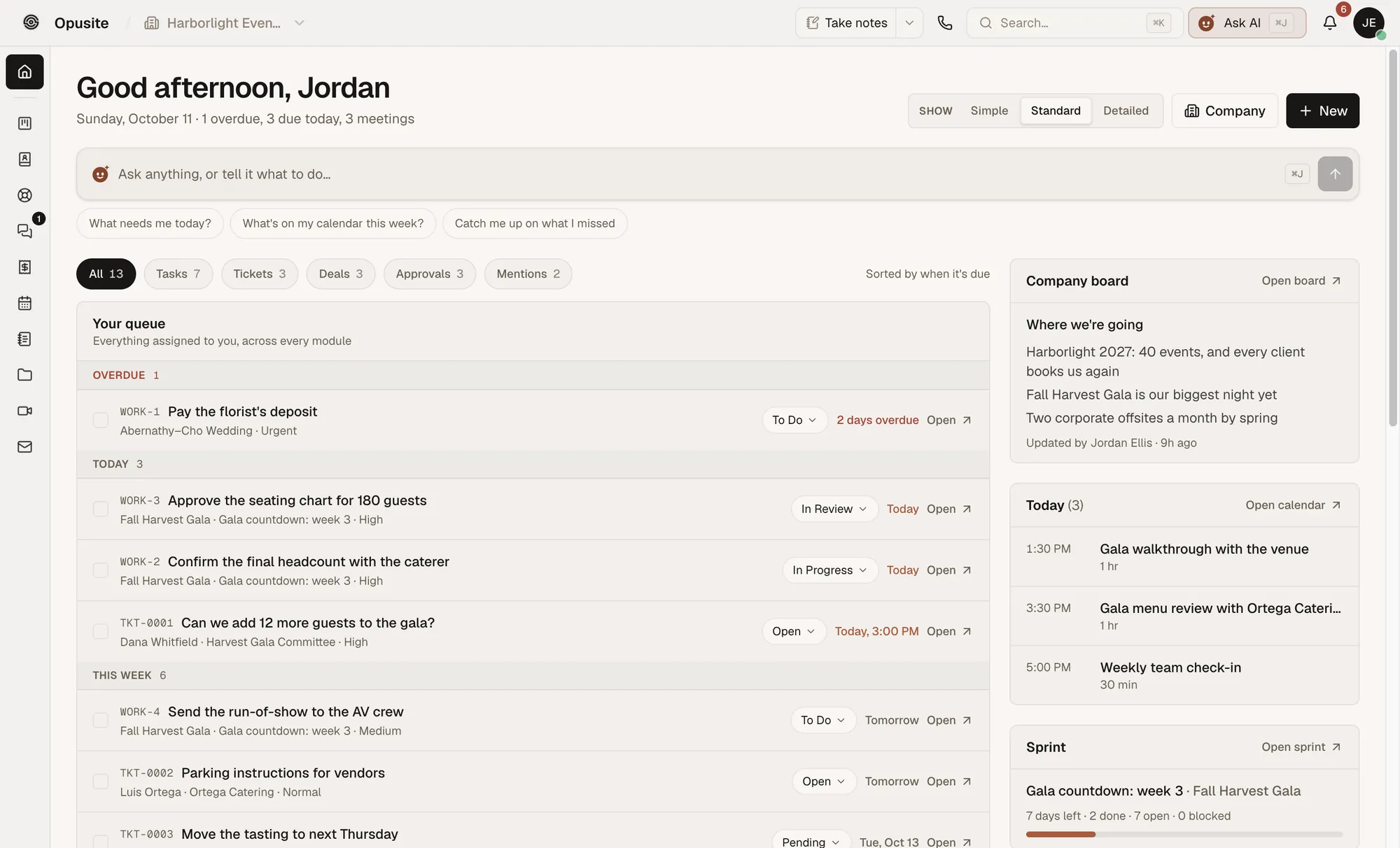
What replaces what. If you are moving from Odoo's service apps, this is the map:
| Odoo app | In Opusite | Opusite plan |
|---|---|---|
| CRM | CRM | Business |
| Project and Timesheets | Workbench: boards, sprints and time logged on each task | Business or Operations |
| Helpdesk | Help Desk: SLA targets and a customer portal | Business |
| Discuss | Messaging | Business or Operations |
| Knowledge | Pages | Every seat |
| Documents | Files | Every seat |
| Spreadsheet | Sheets | Every seat |
| Sign | Signatures | Business |
| Email Marketing | Campaigns | Business |
| Events | Events | Business |
| Surveys | Forms | Business |
| Expenses | Expense Reports | Business |
| Invoicing | Invoices | Business |
| Appointments | Appointments | Operations |
| Field Service | Jobs | Operations |
| Planning and Attendances | Workforce: shift schedules and a tablet clock-in with a PIN | Operations |
| Accounting | Not replaced: keep QuickBooks or Xero | None |
| Inventory, Manufacturing, Purchase, eCommerce, Point of Sale, Payroll | Not in Opusite's plans | None |
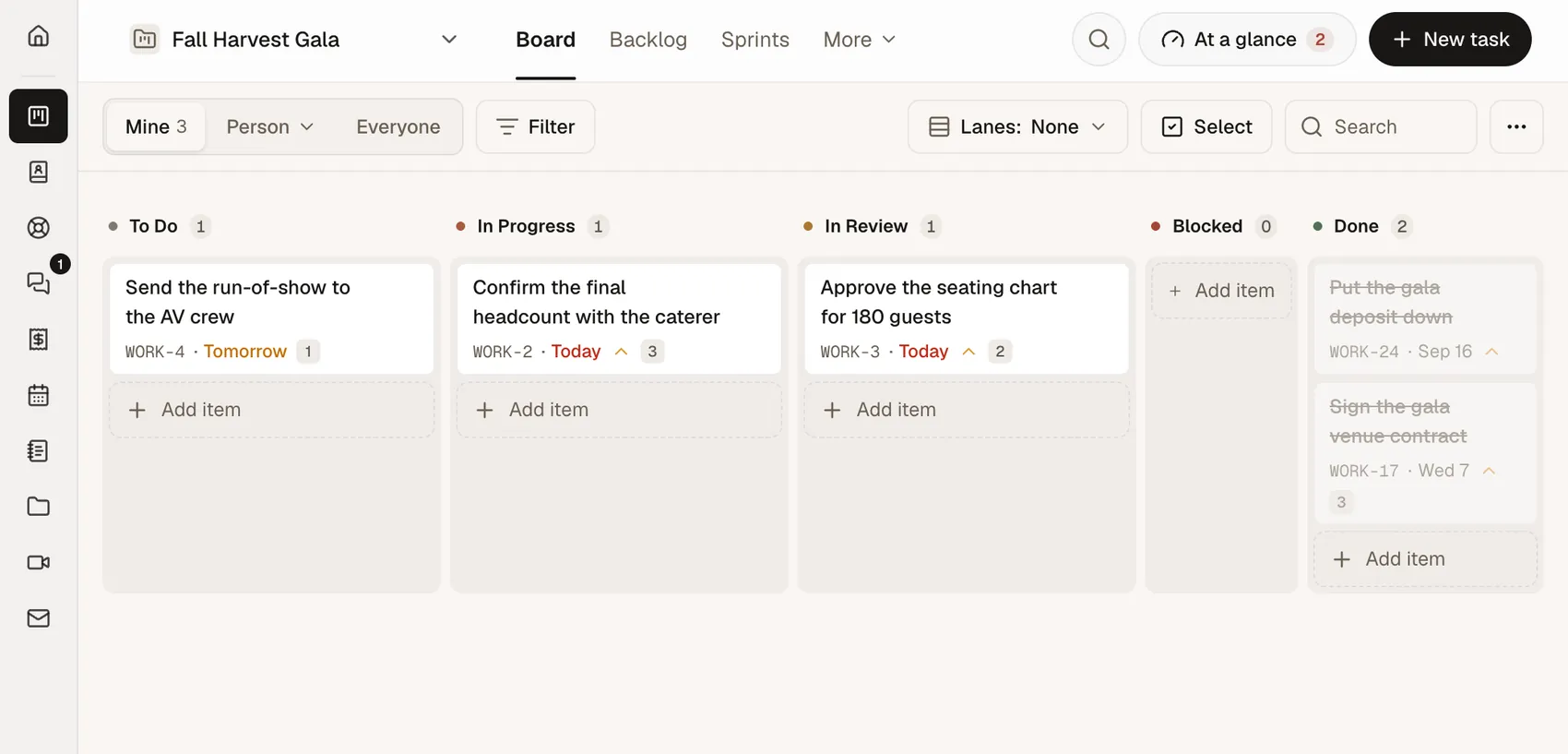
Price. $150 a seat a month for Business or Operations, $225 a seat for both, sold in steps of 3, 6 or 9 seats, month to month with no yearly plan. Ten seats or more are priced with you. Every seat includes the Personal tools (Pages, Meetings, Email, Vault, Calendar, Sheets, Boards, Files, Analytics, Presentations and Ask Opusite), and every company gets $25 of AI use a month. People who only fill in your forms, book an appointment or open an invoice are not seats. Setup is a 30-minute call, after which your team is invited and your tools are switched on.
Where it falls short. It costs about six times Odoo Standard per seat in the first year. It does not do inventory, manufacturing, purchasing, online stores, point of sale or payroll, and it is not full bookkeeping. Phone and social posting are marked coming soon. It is invite-only today, so the way in is a demo call, not a sign-up button.
Pick it if you are a service team that would rather pay more per seat for a workspace set up with you than pay a partner to configure Odoo. Skip it if Odoo runs your stock, your factory floor, your online shop, your payroll or your books. See what each Opusite plan includes and costs.
How to move off Odoo without losing anything
- Export every list you rely on. In Odoo, open the list view, tick the records, choose Actions, then Export, pick the fields, and save as Excel (.xlsx) or CSV. Save an export template for anything you will export more than once.
- Download a full backup. On Odoo Online, the control center lets you download a backup of the whole database at any time. Keep it even after you switch.
- Keep the columns that matter. For customers: name, email, phone, company, salesperson and tags. For open work: the task, who owns it, its due date and its project. For money: invoice numbers, amounts and due dates.
- Move your books first, or not at all. If Odoo holds your accounting, decide where the books go (QuickBooks, Xero or another ERP) before you move anything else, and close a period in Odoo before you do.
- Rebuild automations last. Studio fields, automated actions and email templates do not move between products. List the three you actually rely on and rebuild those.
- Run both for two weeks. Keep Odoo read-only while the team works in the new tool, then cancel.
Opusite's CRM imports contacts and companies from a CSV or Excel file, up to 25,000 rows at a time, matching columns such as name, email, phone and company. It does not import deals, so open deals, tasks and tickets are set up by hand. Setup is a 30-minute call with us, so you are not doing it alone. The CRM with project management guide shows how a deal and its work sit together afterwards.
How to choose, in five questions
- Which Odoo apps do you open every week? If the list includes Inventory, Manufacturing, Purchase or Accounting, stay with an ERP: ERPNext, Dolibarr, Business Central, SAP Business One or Acumatica. If it is CRM, Project, Helpdesk and Discuss, you have more choice and can drop the ERP.
- Who will set it up? Odoo, the other ERPs, the open-source tools, Zoho One and Bitrix24 all work best with a partner or someone in-house who likes configuring software. HubSpot and Pipedrive are self-serve. Opusite is set up with you on a call.
- How many people need access, and how much? If many people need a little access, Odoo's new Light User rule, Acumatica's unlimited users and Bitrix24's flat price work very differently. Count your people before you compare per-user prices.
- What will the price be in month 13? Odoo's $24.90 and HubSpot's $7 are first-year or new-customer prices. Zoho One's $37 needs every employee licensed. Opusite's $150 a seat is the same in month 1 and month 13.
- Do you need to host it yourself? If yes, the free choices are ERPNext, Dolibarr, OpenProject Community and Odoo Community. Acumatica's partners offer more than one deployment option; ask any partner-sold ERP where it can run. Zoho One, Bitrix24's plans above, Cin7, HubSpot, Pipedrive and Opusite are cloud software.
How we checked these prices
Each price was read from the vendor's own US pricing page on October 15, 2026, and a figure tied to yearly or monthly billing is labelled that way. For Odoo, Zoho One, Bitrix24, HubSpot and OpenProject we give both; Pipedrive's figures are its annual-billing prices. OpenProject was read with its hosting switch on Cloud and on On-premises, and HubSpot with its billing switch on both settings. Odoo's page was read from its raw HTML, where each figure is labelled as yearly or monthly. The September changes at Odoo were checked against the copies of Odoo's pricing page saved by the Internet Archive on August 11, September 17 and September 25, 2026. Where a page showed no price (SAP Business One, Acumatica) or refused our requests (NetSuite), we say so rather than guess. Promotional prices are marked as such. Vendors change prices without notice, so check the source before you buy, and tell us at sales@opusite.com if a figure here is out of date.
Sources
Read on October 15, 2026, from the United States.
- Odoo pricing: https://www.odoo.com/pricing
- Odoo Success Packs: https://www.odoo.com/pricing-packs
- Odoo documentation, Export and import data: https://www.odoo.com/documentation/20.0/applications/essentials/export_import_data.html
- Internet Archive copies of Odoo's pricing page: https://web.archive.org/web/20260811122803/https://www.odoo.com/pricing, https://web.archive.org/web/20260917103615/https://www.odoo.com/pricing and https://web.archive.org/web/20260925101651/https://www.odoo.com/pricing
- The Brussels Times with Belga, "Odoo announces €10-billion valuation and a partial price increase", September 24, 2026: https://www.brusselstimes.com/business/2332306/odoo-announces-e10-billion-valuation-and-a-partial-price-increase
- ERPNext pricing: https://frappe.io/erpnext/pricing
- Frappe Cloud pricing: https://frappe.io/cloud/pricing
- ERPNext on GitHub (licence): https://github.com/frappe/erpnext
- Frappe, "Here's why Open Source ERPNext is better than Odoo": https://frappe.io/erpnext/comparisons/erpnext-vs-odoo
- Dolibarr features: https://www.dolibarr.org/
- DoliCloud: https://www.dolicloud.com/en/
- Zoho One pricing: https://www.zoho.com/one/pricing/
- Bitrix24 pricing: https://www.bitrix24.com/prices/
- Microsoft Dynamics 365 Business Central pricing: https://www.microsoft.com/en-us/dynamics-365/products/business-central/pricing
- SAP Business One: https://www.sap.com/products/erp/business-one.html
- Acumatica pricing: https://www.acumatica.com/pricing/
- Cin7 pricing: https://www.cin7.com/pricing/
- HubSpot pricing: https://www.hubspot.com/pricing/crm
- Pipedrive pricing: https://www.pipedrive.com/en/pricing
- OpenProject pricing: https://www.openproject.org/pricing/
- OpenProject, "Best Odoo Alternative": https://www.openproject.org/project-management-software-alternatives/best-odoo-alternative/
- Reddit r/CRM, "Alternative to Odoo": https://www.reddit.com/r/CRM/comments/1o3co1d/alternative_to_odoo/
- Opusite pricing: /pricing
- European Central Bank euro reference rates (US dollar, October 15, 2026: 1.1208): https://www.ecb.europa.eu/stats/eurofxref/eurofxref-daily.xml
Questions people ask
- Who is the biggest competitor of Odoo?
- There is no single one, because Odoo competes in several markets at once. Among open-source ERPs it is ERPNext. Among cloud suites for small businesses it is Zoho One and Bitrix24. Among ERPs bought through partners by growing companies it is Microsoft Dynamics 365 Business Central, SAP Business One, NetSuite and Acumatica. Against Odoo's CRM app alone it is HubSpot and Pipedrive, and against its Project app alone it is OpenProject.
- What's better than Odoo?
- Nothing is better at everything Odoo does, but several tools are better at one part of it. ERPNext if you want ERP software with no paid tier at all. Cin7 if stock and orders are the whole job. Business Central or SAP Business One if you want a large vendor's ERP set up by a partner. HubSpot or Pipedrive if you only need a CRM. Opusite if you are a service team of 5 to 20 people that wants CRM, projects, help desk and chat set up for you, and can pay more per seat for that.
- Is ERPNext 100% free?
- The software is. ERPNext is open source under the GPL-3.0 licence, and its maker, Frappe, says it has no paid features behind a paywall. You pay to run it: Frappe Cloud hosting starts at $5 a month for a site, priced by the resources you use rather than per user, or you host it on your own server. Frappe does not set ERPNext up for you; you do that yourself or hire one of its partners at their rates.
- Is Odoo similar to SAP?
- In scope, yes. In how you buy it, no. Both are ERP suites that cover accounting, purchasing, inventory, sales and customer records. SAP's small-business product, SAP Business One, is sold through partners and its page shows no price; SAP says more than 85,000 customers use it. Odoo publishes its prices: Standard is $24.90 a user a month billed yearly in the first year and $31.10 after, and small companies often buy setup hours from Odoo itself.
- Is Odoo difficult to use?
- Using it day to day is not the hard part; setting it up is. Odoo's own figures say projects with one of its Success Packs succeed 98% of the time, against 65% without one. The smallest pack is 4 hours for $580 ($493 for a new customer's first pack), and the 200-hour Pro pack is $25,000. Odoo says companies under 50 employees usually work with it directly through these packs.
- What is the disadvantage of using Odoo?
- Four come up most. Setup help is extra, and for a small team it can cost more than a year of licences. Customising with Odoo Studio, running more than one company or using the external API moves you to the Custom plan at $49 a user a month billed yearly, about twice Standard. The $24.90 Standard price lasts 12 months and applies to the users on your first order. And since late September 2026, an employee record with no login counts as a Light User at $8.90 a month.
- Does Odoo replace QuickBooks?
- It can. Odoo's Accounting app is included in its Standard and Custom plans, so a company that moves its books into Odoo can stop paying for QuickBooks. Many Odoo alternatives cannot do that. Opusite, for example, sends invoices and tracks expenses but is not full bookkeeping, so its customers keep QuickBooks or Xero for their books.
- Is Odoo good for manufacturing companies?
- It covers manufacturing in its standard plans: Odoo groups Manufacturing, PLM, Quality and Maintenance among its apps, and its Light User licence lets shop-floor staff use the Manufacturing shop floor. If you need a different system, Business Central Premium adds manufacturing to Microsoft's ERP at $110 a user a month paid yearly, and Cin7 Pro adds material requirements planning to its inventory system at $599 a month for 10 users.
- Do people still use Odoo?
- Yes, and more each year. At its September 2026 conference Odoo said it has 28 million users, about 80% of them on free plans, and that its 2026 turnover was up 48% on the same period a year earlier, according to The Brussels Times and Belga. At the same event it announced its first price increase in four years, of about 20%.
- Is Odoo an ERP or a CRM?
- An ERP that includes a CRM. Odoo's Standard plan covers all of its apps, from CRM and Sales to Accounting, Inventory, Project and HR, for one price per user. You can also use the CRM on its own: Odoo's One App Free plan gives one app to unlimited users at no cost.
- Who is the best Odoo partner?
- Odoo's own guidance depends on your size. Companies under 50 employees usually work directly with Odoo using Success Packs. Companies over 50 usually work with a partner from Odoo's partner directory. Companies of 250 or more are asked to contact Odoo directly. We do not rank partners; ask any partner which companies of your size and trade they have set up, and what those projects cost.
- What software is similar to Odoo?
- ERPNext and Dolibarr are the closest: both are open-source suites that cover stock, projects and accounting, and both can be hosted by you or for you. Google's AI answer for 'odoo competitors' also names Flectra and Tryton, two other open-source projects, citing an r/Odoo thread. Among paid cloud suites, Zoho One and Bitrix24 sell many apps under one subscription the way Odoo does.
- How do I get my data out of Odoo?
- From any list in Odoo, tick the records, choose Actions, then Export, pick the fields and save the file as Excel (.xlsx) or CSV. On Odoo Online you can also download a backup of the whole database from the control center at any time. Export customers, products, open orders and invoices before your subscription ends, and keep the files.